Analysis
How to build a banking SOC in Chad
A banking SOC cannot be bought off the shelf: it is built step by step, around each bank’s own risks. Here is the approach GSS recommends to Chadian financial institutions.
Cyril KOSSADI KLAMADJI, IT Manager & Solution Builder, GSS Published on 7 min read
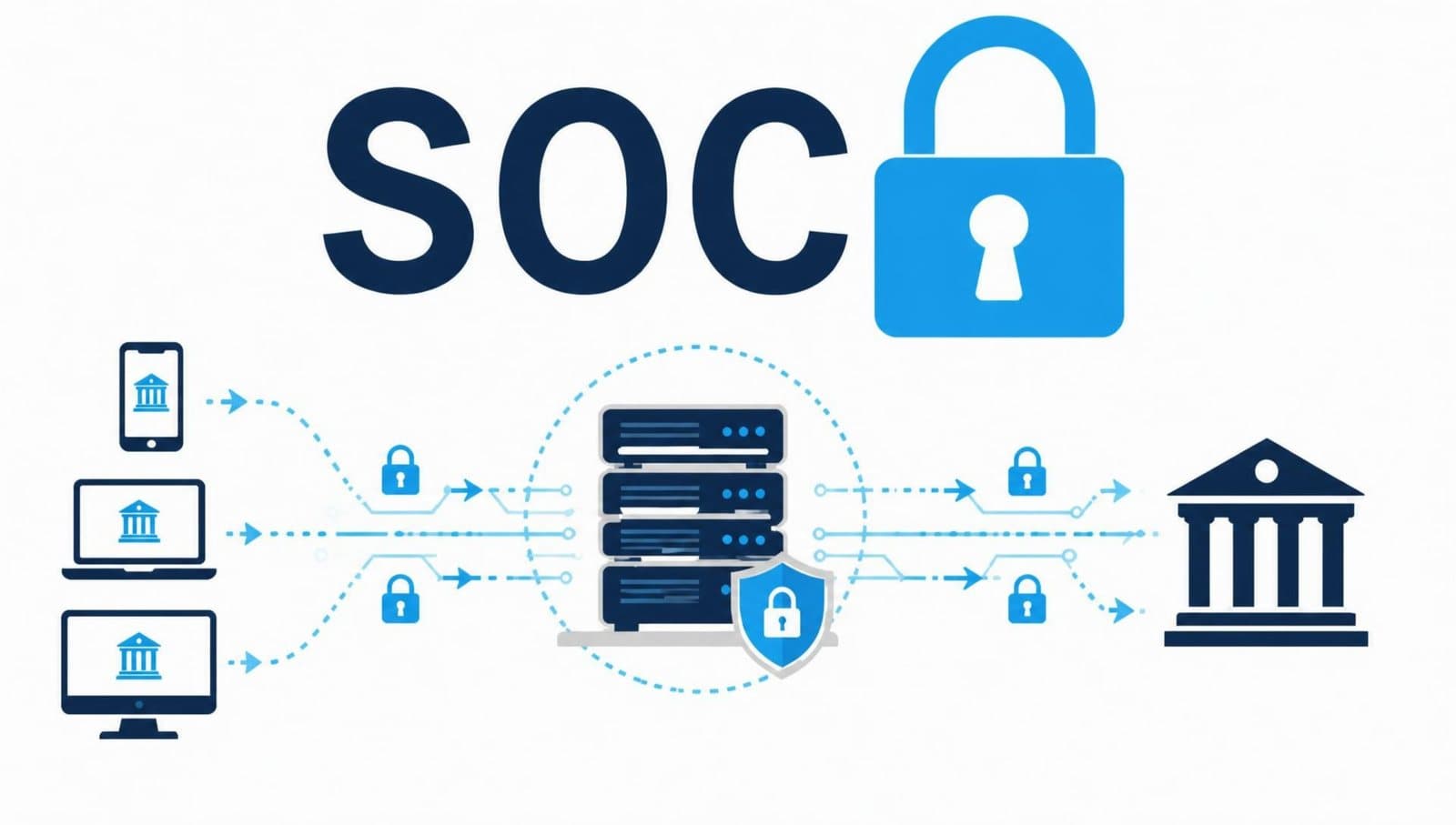
Chadian banks are going through an unprecedented digital acceleration: online banking, mobile apps, interoperable cards, instant payments and connections to mobile money. Every new channel also opens a new door for attackers.
In this reality, firewalls and antivirus software are no longer enough. A bank must be able to see what is happening across its information system, detect an attack in progress and respond within minutes, day and night. That is precisely the role of a Security Operations Center (SOC).
A context that makes the SOC essential
The banking sector is a prime target for cybercriminals, in Central Africa as elsewhere. The most common scenarios are well known:
- Card and transaction fraud: card compromise, diversion of payment flows, abuse of interfaces with mobile money operators.
- Phishing and identity theft targeting customers and staff alike, often the first step in a wider intrusion.
- Ransomware capable of paralysing core banking and branches for several days.
- Insider threats: poorly controlled privileged accounts, service providers with remote access.
- Attacks on interbank payment systems, whose impact goes beyond a single bank.
The regulatory framework points in the same direction. At regional level, BEAC and COBAC expect institutions to control their operational and IT risks, and CEMAC payment interoperability requires every participant to maintain a level of security worthy of the ecosystem. At national level, Chad’s cybersecurity and personal data protection framework, driven in particular by ANSICE, places incident detection and management at the heart of the obligations of sensitive operators.
In other words, the question is no longer whether a SOC is needed, but how to build one in a realistic and sustainable way.
What is a banking SOC?
A SOC brings together a team, processes and tools to continuously monitor the information system, detect security incidents and respond to them. In a bank, its scope primarily covers core banking, card payments, digital channels, email, Active Directory, workstations and links with branches and partners.
Three operating models are possible:
| Model | Principle | Strengths | Watch-outs |
|---|---|---|---|
| In-house SOC | The bank recruits, equips and runs its own centre | Full control, data kept in-house | High cost, hard to recruit and to ensure 24/7 coverage |
| Outsourced SOC (managed SOC) | A specialist provider handles monitoring | Fast start-up, pooled expertise | Less business knowledge, dependence on the provider |
| Hybrid SOC | Tools and data stay in the bank, operations shared with a partner | Balance between cost and control, skills transfer | Clear governance between both parties is essential |
For most Chadian banks, the hybrid model offers the best compromise: the bank keeps control of its data and decisions while relying on a partner for out-of-hours monitoring and specialist expertise.
Building a SOC in seven steps
- Start from the risks. Everything begins with a risk analysis: which assets are critical (core banking, card payments, SWIFT, mobile banking)? Which scenarios are most feared? This mapping sets the SOC’s scope, priorities and budget.
- Establish governance. The SOC needs a sponsor in senior management, a clear reporting line (often to the CISO) and escalation rules agreed with IT, compliance, legal and communications. Who decides to isolate a server at 3 a.m. on a Sunday? The answer must be written down before the incident.
- Collect the right sources. Before buying a tool, decide which logs to collect: firewalls, Active Directory, critical servers, business applications, EDR, VPN, email. A few well-used sources are better than a mass of unused data.
- Deploy the technical foundation. A modern SOC relies on a few complementary building blocks:
- a SIEM that centralises and correlates events;
- an EDR / XDR to detect and contain threats on workstations and servers;
- network detection (NDR) on sensitive flows;
- a SOAR to automate repetitive responses;
- a threat intelligence and external attack surface monitoring service (fraudulent domains, credential leaks, fake social media accounts).
- Write business use cases. The value of a banking SOC lies in its detection rules: abnormal logins to privileged accounts, suspicious creation of beneficiaries, out-of-hours access to core banking, unusual card payment volumes, an antivirus disabled on a branch workstation. These use cases are built with the business, not only with IT.
- Formalise processes and playbooks. Each type of incident (phishing, ransomware, card fraud, compromised account) has a response procedure: qualification, containment, eradication, recovery and lessons learned. Playbooks are tested regularly through exercises.
- Train teams and scale up gradually. Level 1, 2 and 3 analysts, SIEM engineers, a SOC manager: these profiles are developed over time. The SOC can start during business hours on a limited scope, before extending coverage and moving to 24/7.
The realities on the ground in Chad
A European SOC model cannot simply be copied in N’Djamena. Five constraints must be built in from the design stage:
- Scarce skills. Experienced cybersecurity analysts are few on the local market. Training, certification and talent retention must be planned, supported by realistic training environments (cyber ranges).
- Connectivity and power. Links with provincial branches and power cuts call for a resilient architecture: redundant links, backup power and local collection able to store logs during an outage.
- Data sovereignty. A bank’s logs contain sensitive and personal data. Where they are hosted, how long they are kept and whether they leave the country must be decided in line with the national framework and the regulator’s requirements.
- Cost control. Some tools are licensed by data volume. Realistic sizing, well-chosen technologies and a gradual ramp-up avoid budget surprises.
- Proximity. In a major incident, a team able to be physically on site within the day often makes the difference.
Measuring SOC performance
A SOC is managed through indicators reviewed by the executive committee:
| Indicator | What it measures |
|---|---|
| MTTD (Mean Time To Detect) | The average time between the start of an attack and its detection |
| MTTR (Mean Time To Respond) | The average time between detection and containment of the incident |
| Coverage of critical assets | The share of sensitive systems whose logs reach the SOC |
| False positive rate | The quality of detection rules and the unnecessary workload on analysts |
| MITRE ATT&CK coverage | The share of known attack techniques it can detect |
| Exercises conducted | The number of crisis simulations and playbook tests run during the year |
These indicators show the SOC’s value to senior management and the regulator, and guide the following year’s investments.
The GSS approach: end-to-end support
Global Synergies Solutions supports financial institutions at every stage of their SOC project, from risk analysis to operations:
- Audit and scoping: maturity assessment, risk mapping, choice of target model (in-house, outsourced or hybrid) and roadmap.
- Technology integration: deployment and configuration of security building blocks with our partner ecosystem, including Fortinet for network security, SIEM and EDR, CTM360 for external attack surface monitoring and digital fraud prevention, and CyberSpector.
- Design of use cases and playbooks tailored to banking and card payment processes in the CEMAC region.
- Team training and drills, notably through realistic attack simulations with our partner Cyber Ranges.
- Operational support in a hybrid model, with gradual transfer of skills to the bank’s teams.
Our strength: in-depth knowledge of the financial sector and Central Africa’s payment ecosystem, combined with the proximity of a team based in N’Djamena.
Conclusion
Building a banking SOC in Chad is as much a transformation project as a technology one. The banks that succeed start from their real risks, move forward in stages, invest in their teams and choose partners able to support them over the long term.
Is your institution considering a security operations centre? GSS experts offer a maturity assessment to define together the most suitable roadmap. Contact us.