Analysis
Cybersecurity: why train for an attack before it happens
When facing cyberattacks, technology is not enough: it is teams that detect, analyse and respond. To prepare them, GSS offers Chadian organisations simulation-based training with its partner CYBER RANGES, a platform that recreates realistic attacks in a risk-free environment.
ISSA Mahamat Saleh Khalifa, Chief Information Officer, GSS Published on 5 min read
An attack leaves no time to learn
During an incident, every minute counts. Who isolates the compromised server? Who informs management? Should the connection with a partner be cut? Organisations that discover these questions in the middle of a crisis lose precious time.
Firefighters and pilots train regularly in realistic conditions. Cybersecurity follows the same logic: a team that has already faced a simulated attack responds faster and more confidently to a real one.
What is a cyber range?
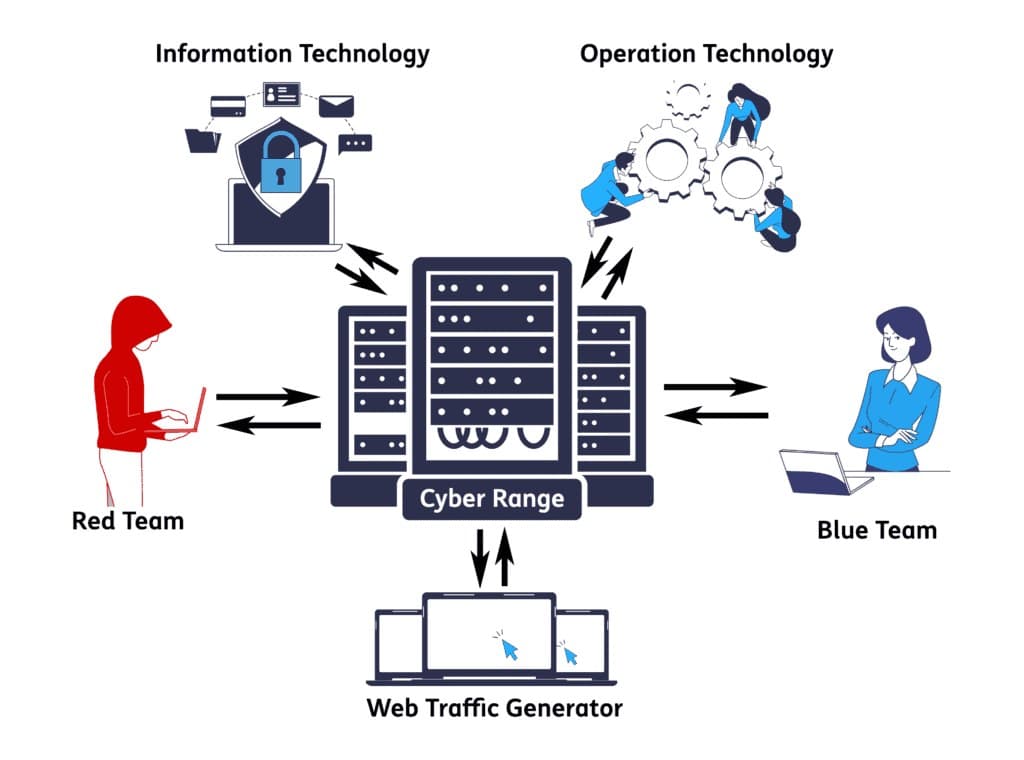
A cyber range is a digital firing range. It recreates a complete information system, with its servers, networks, workstations and, if needed, industrial equipment. Attack scenarios are launched within it: ransomware, intrusion, data theft.
Participants must detect, analyse and contain the attack, with no risk to production systems. At the end of the exercise, their performance is measured, both individually and as a team.
What training brings to organisations
- Reflexes acquired before the crisis. Teams learn the right moves in near-real conditions.
- Procedures put to the test. Incident response plans are tested and corrected before they are needed.
- Objective skills assessment. Results help identify training needs and target investments.
- An answer to scarce talent. In Chad, experienced cybersecurity analysts are few. Simulation helps train local talent faster.
CYBER RANGES, an international reference
CYBER RANGES is a company specialising in cyber simulation environments, present in Cyprus, the United States, the United Kingdom, Kenya and Estonia. It provided the technical scenarios for the 2024 and 2025 Global CyberDrill of the International Telecommunication Union (ITU), the United Nations specialised agency for information and communication technologies.
Its scenarios are built on MITRE ATT&CK, the international framework of attack techniques. The platform can be used on demand, in a hosted private environment, installed on premises or as a portable solution, adapting it to each organisation’s constraints.
Who is this offer for?
- public administrations and incident response teams (CERTs, CSIRTs);
- banks and financial institutions;
- telecom operators and critical infrastructure;
- defence and security forces;
- universities and schools training the next generation of cybersecurity experts.
The GSS approach
GSS supports Chadian organisations from start to finish:
- defining training objectives;
- choosing the deployment option;
- adapting scenarios to local realities;
- running exercises and tracking team progress.
Conclusion
The question is no longer whether an organisation will be attacked, but whether its teams will be ready. Training before the attack turns the crisis into a familiar exercise rather than a painful discovery.
Would you like to assess your teams’ readiness or organise a cyber defence exercise? Contact GSS experts.